The presence of Christ by the power of the Word and of the Holy Spirit
“Christ Jesus, who died, yes, who was raised from the dead, who is at the right hand of God, who indeed intercedes for us” (Romans 8,34), is present in his Church in many ways: in his Word, in the prayer of his Church — “for where two or three are gathered in my name, there am I in the midst of them” (Matthew 18,20), then among the poor, in the sick and in those in prison (Matthew 25,31-46). He is present in the sacraments which he instituted, in the sacrifice of the Mass and in the person of the minister, but “above all he is present in the Eucharist”.
The manner of Christ’s presence in the Eucharist is unique. It raises the Eucharist above all the sacraments and makes it “the summit of the spiritual life and the end towards which all the sacraments tend.” In the Most Blessed Sacrament of the Eucharist “the body and blood of our Lord Jesus Christ, together with his soul and his divinity, and therefore the whole Christ, are truly and substantially contained.” “This presence is called real not in an exclusive sense, as though the other presences were not real, but because of its particular character: it is a substantial presence, and through it the whole Christ, God and man, is present.”
At the Council of Trent the Catholic faith on this point was summed up in the following declaration: “Because Christ our Redeemer said that what he was offering under the visible form of bread was truly his Body, it has always been the conviction of the Church of God, and this holy Council now declares it again: by the consecration of the bread and of the wine there takes place a change of the whole substance of the bread into the substance of the Body of Christ our Lord, and of the whole substance of the wine into the substance of his Blood. This change the Catholic Church has fittingly and properly called transubstantiation.”
The eucharistic presence of Christ begins at the moment of the consecration and lasts as long as the eucharistic species subsist. Christ is present whole and entire in each of the species and whole and entire in each of their parts, so that the breaking of the bread does not divide Christ.
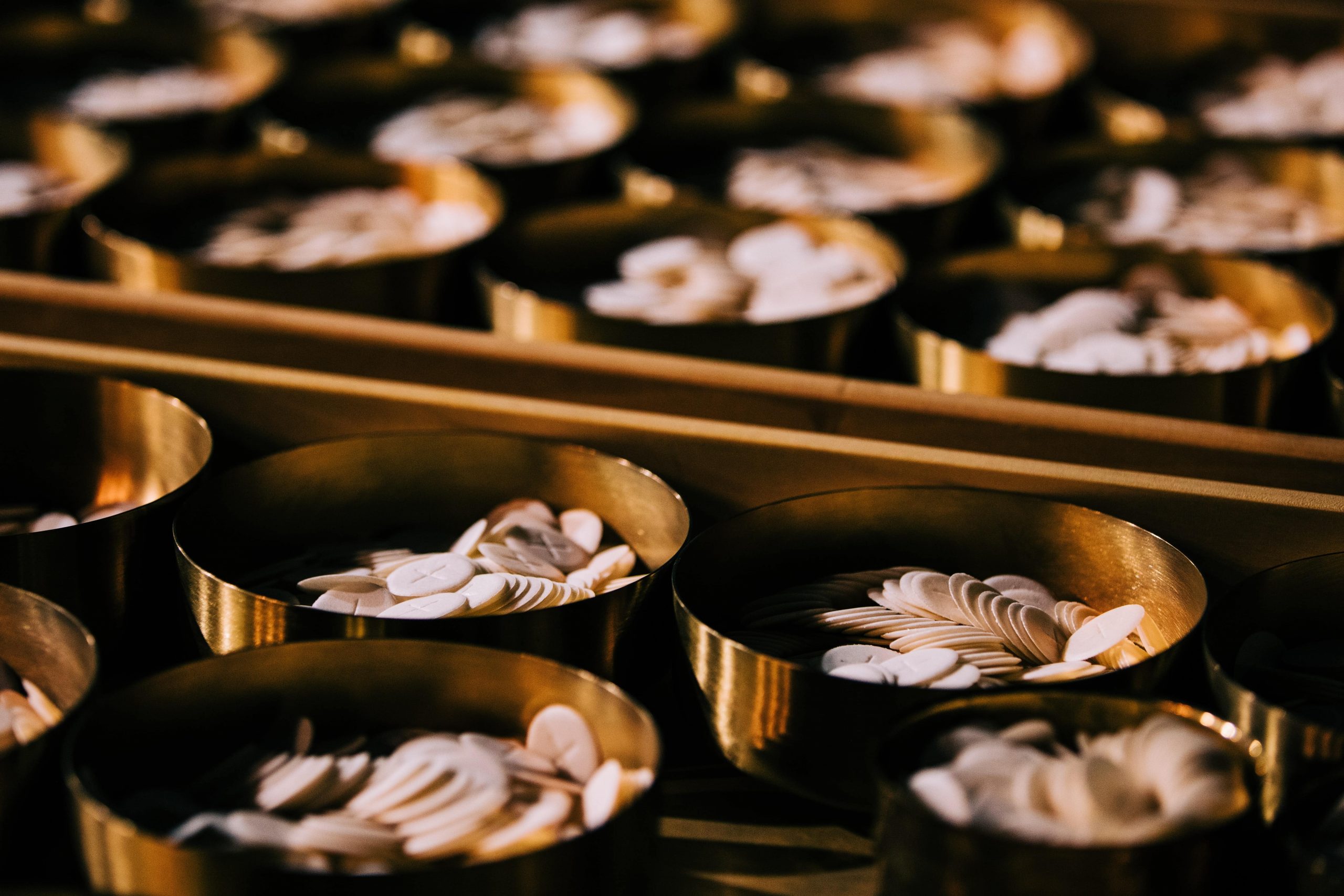
The veneration of the Eucharist
In the liturgy of the Mass we express our faith in the real presence of Christ under the species of bread and wine, among other ways by genuflecting or bowing deeply before the Lord. “The Catholic Church has offered and continues to offer to the sacrament of the Eucharist this worship of adoration, not only during Mass but also outside it: reserving the consecrated hosts with the greatest care, exposing them for the solemn veneration of the faithful and carrying them in procession.” The tabernacle was at first intended for the worthy reservation of the Eucharist for the sick and for those who could not be present at Mass. But as faith in the real presence of Christ in the Eucharist deepened, the Church became aware of the meaning of silent adoration before the Lord present under the eucharistic species. For this reason the tabernacle should be placed in a worthy part of the church, and it should be so made that it sets forth and shows the truth of the real presence of Christ in the Blessed Sacrament. It is fitting indeed that Jesus should have wished to remain present to his Church in this unique way. Since he was about to leave his own in his visible form, he wished to give us his sacramental presence; since he was about to offer himself on the cross for our salvation, he wished to leave us the memorial of the love with which he loved us “to the end” (John 13,1), even to the gift of his life. In his eucharistic presence he remains mysteriously in our midst as the one who loved us and gave himself up for us, and he remains under the signs that express his love for us: the Church and the world have great need of eucharistic worship. Jesus awaits us in this sacrament of love. Let us not begrudge the time to go and meet him in adoration, in contemplation full of faith and ready to make amends for the great sins and crimes of the world. Let our adoration never cease. “That the true Body and the true Blood of Christ are present in this sacrament cannot be perceived by the senses, says St Thomas, but only by faith, which rests on the authority of God.”
The Paschal banquet
The Mass is at one and the same time the sacrificial memorial in which the sacrifice of the Cross is perpetuated, and the sacred banquet of communion with the Lord’s Body and Blood. But the whole celebration of the eucharistic sacrifice is directed towards the deepest union of the faithful with Christ through communion. To receive communion is to receive Christ himself, who offered himself for us.
The altar, around which the Church gathers in the celebration of the Eucharist, represents two aspects of the same mystery: the altar of sacrifice and the table of the Lord; and all the more so because the Christian altar is the symbol of Christ himself, present in the assembly of his faithful both as the victim offered for our reconciliation and as the heavenly food that is given to us. “What is the altar of Christ but the image of the Body of Christ?” says St Ambrose, and elsewhere: “The altar represents the Body of Christ, and the Body of Christ is upon the altar.” The liturgy expresses this unity of sacrifice and communion in many prayers. Thus the Church of Rome prays in her eucharistic prayer: We humbly beseech you, almighty God, that the hands of your holy angels may bear this offering to your altar on high, in the sight of your divine majesty, so that all of us who receive the most holy Body and Blood of your Son may, as sharers in this sacrifice, be filled with every heavenly blessing and grace,
“Take this, all of you, and eat of it” — Holy Communion
The Lord calls us to receive him in the sacrament of the Eucharist: “Truly, truly, I say to you, unless you eat the flesh of the Son of Man and drink his blood, you have no life in you.” (John 6,53)
If we are to answer this call, we must prepare ourselves. St Paul calls for an examination of conscience: “Whoever, therefore, eats this bread or drinks the cup of the Lord unworthily will be guilty of the Body and Blood of the Lord. Let a man examine himself, and only then eat of this bread and drink of this cup. For anyone who eats and drinks unworthily eats and drinks judgement upon himself, because he does not discern the Body of the Lord.” (1 Corinthians 11,27-29) Anyone who is aware of a grave sin should go to confession before coming to communion.
Before so great a mystery the faithful can only take up humbly, and with strong faith, the confession of the centurion and say: “Lord, I am not worthy that you should enter under my roof, but only say the word and my soul shall be healed.”
Frequent communion
It is wholly in keeping with the very meaning of the Eucharist that the faithful, if they have the required dispositions, should receive communion each time they take part in the Mass. “That more perfect participation in the Mass is warmly recommended whereby the faithful, after the priest’s communion, receive the Lord’s Body from the same sacrifice.” The Church obliges the faithful “to take part in the divine liturgy on Sundays and feast days” and to receive the Eucharist at least once a year, if possible during the Easter season and prepared by the sacrament of confession. The Church nevertheless encourages the faithful to receive the Holy Eucharist on Sundays and feast days as well, or more often still, every day.
Since Christ is sacramentally present under each of the species, communion under the species of bread alone makes it possible to receive all the fruit of eucharistic grace. For pastoral reasons this manner of receiving communion was established by law in the Latin rite as the more usual one. Nevertheless, “Holy Communion has a fuller form as a sign when it is received under both kinds: in that form the sign of the eucharistic banquet appears more perfectly.” This is the usual form of receiving communion in the Eastern rites.